



Wine market 2027: challenge for Buyers and Winemakers

You are a buyer and you are hesitant to list new wines for next year. You are a winemaker and you do not yet know which markets to focus on to present your next vintage. In both cases, the question is the same: how do you build 2027 when yesterday’s benchmarks no longer hold?
Trade tensions, customs duties that change from one year to the next, declining wine consumption in several historic markets, unstable logistics and energy costs, increasingly frequent weather events… The context makes it hard to look ahead. And yet, decisions have to be made now.
A challenge shared on both sides of the table
Buyers and producers are often seen as having opposing interests. In reality, you face the same problem: a lack of visibility that makes every commitment riskier. Buyers hesitate to commit, winemakers hesitate to invest, and each waits for the other to make the first move. The result: decisions are postponed, and opportunities slip away.
Buyers’ obstacles
If you are an importer, distributor, wine merchant or restaurateur, these obstacles will probably sound familiar.
Caution with stock. With less predictable demand, tying up cash in large volumes becomes hard to justify. You prefer smaller, more frequent orders, which makes it harder to strengthen your relationship with some suppliers.
The risk of listing something new. Trying an unknown estate means taking a gamble. In a tight market, you have less room for error, so you stick with proven wines, at the risk of your customers growing tired of your selection.
The time and cost of prospecting. Trade fairs, travel and on-site tastings require a significant investment. When budgets tighten, this is often the first line to be cut.
Regulatory and tariff uncertainty. For importers, changes in customs duties or import rules can alter the economics of an entire range within a few weeks.
Winemakers’ obstacles
If you are a producer, the constraints are different, but just as real.
Volumes that are hard to predict. Between frost, hail, drought and disease, you do not always know what you will have to sell. Committing to specific volumes with a buyer becomes tricky.
Shrinking historic markets. Some outlets you have relied on for years are slowing down. You need to find new ones, often abroad, without always having the contacts or the time to do so.
The cost of international prospecting. Shipping full bottles, travelling, exhibiting at trade fairs abroad: each step weighs on cash flow that is already under pressure, with a return on investment that is hard to budget for.
More customers for similar revenue. Smaller and more frequent orders, more customers, the same follow-up for each one (emails, quotes, preparation, invoicing, shipping). You spend much more time for the same result, with an effort that is rarely recognised.
Look closer, and your expectations meet
As a buyer, you want to discover new wines without taking excessive risks, to taste before you commit, and to have access to reliable producers who can keep their promises.
As a winemaker, you want to be connected with buyers who are genuinely interested in your profile, to get concrete feedback on your wines, and to reduce the cost of every sales contact.
In both cases, what is at stake is the same: making better decisions, faster, with less risk.
How to move forward despite the context
No one can predict 2027. However, you can organise your business so that it is better able to withstand the unexpected. There are several ways to do this.
Make smaller bets
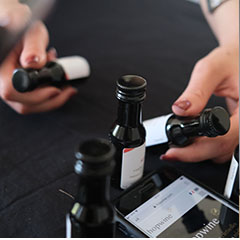
Rather than betting everything on a few large commitments, run more small tests. For a buyer, this means tasting more wines before choosing. For a winemaker, it means getting known by more buyers, across several markets, so you no longer depend on a single outlet.
Stay in touch with markets without relying solely on travel
Trade fairs and face-to-face meetings remain invaluable. But at a time when budgets are closely watched, digital tools make it possible to keep prospecting continuously between two events. You can discover producers or buyers without leaving your cellar or your office, then save your travel for the most promising contacts.
Base decisions on data rather than gut feeling
When the context is unclear, concrete information becomes your best ally. Who tasted your wine? What did they think of it? Which estate profiles match your customers? A well-designed digital tool lets you track these elements, measure genuine interest and adjust your strategy as you go, instead of waiting until the end of the year to take stock.
Build more flexible relationships
In an unstable market, business relationships benefit from being built step by step: a first tasting, a first conversation, a first modest order, then a partnership that grows stronger over time.
Digital does not replace meeting in person, it prepares for it
Let’s be clear: we will never replace the moment when a buyer and a winemaker get together over a glass of wine. Above all, digital tools make that moment rarer, but more useful, and reserved for the people who truly matter.
For 2027, the question may not be how to predict everything, but how to give yourself the means to react quickly. Taste more, test more, talk more, while taking less risk at every step.